Four modes of quality ownership (and when each fails)
When an agent wrote the code and another agent reviewed it, who owns its quality? Most orgs run one of four ownership modes without choosing it. Each one fails in a predictable way at machine speed.
Quality at AI Speed · No. 3
Try this in your next leadership meeting. Ask who owns the quality of a change that an agent wrote, another agent reviewed, and a pipeline promoted to production before lunch.
You'll get an answer from everyone. The team that owns the service will say it's theirs. The platform lead will point at the guardrails. Someone will mention the release board. And the head of QA, if there still is one, will say quality is everyone's job. That's four answers, and it usually means nobody owns it.
This isn't just my impression. In April, Altimetrik and HFS Research surveyed more than 500 senior executives across the Global 2000. They found that most enterprises have deployed AI without settling who is actually in charge of what it decides. Only 14% had a documented AI strategy with clear goals. The rest were dealing with "ownership ambiguity" and governance designed for a world without AI. Engineering leaders say the same thing from the other side: in Qodo's 2026 report, only 3.7% think their current processes can govern quality as agents take on more of the work.
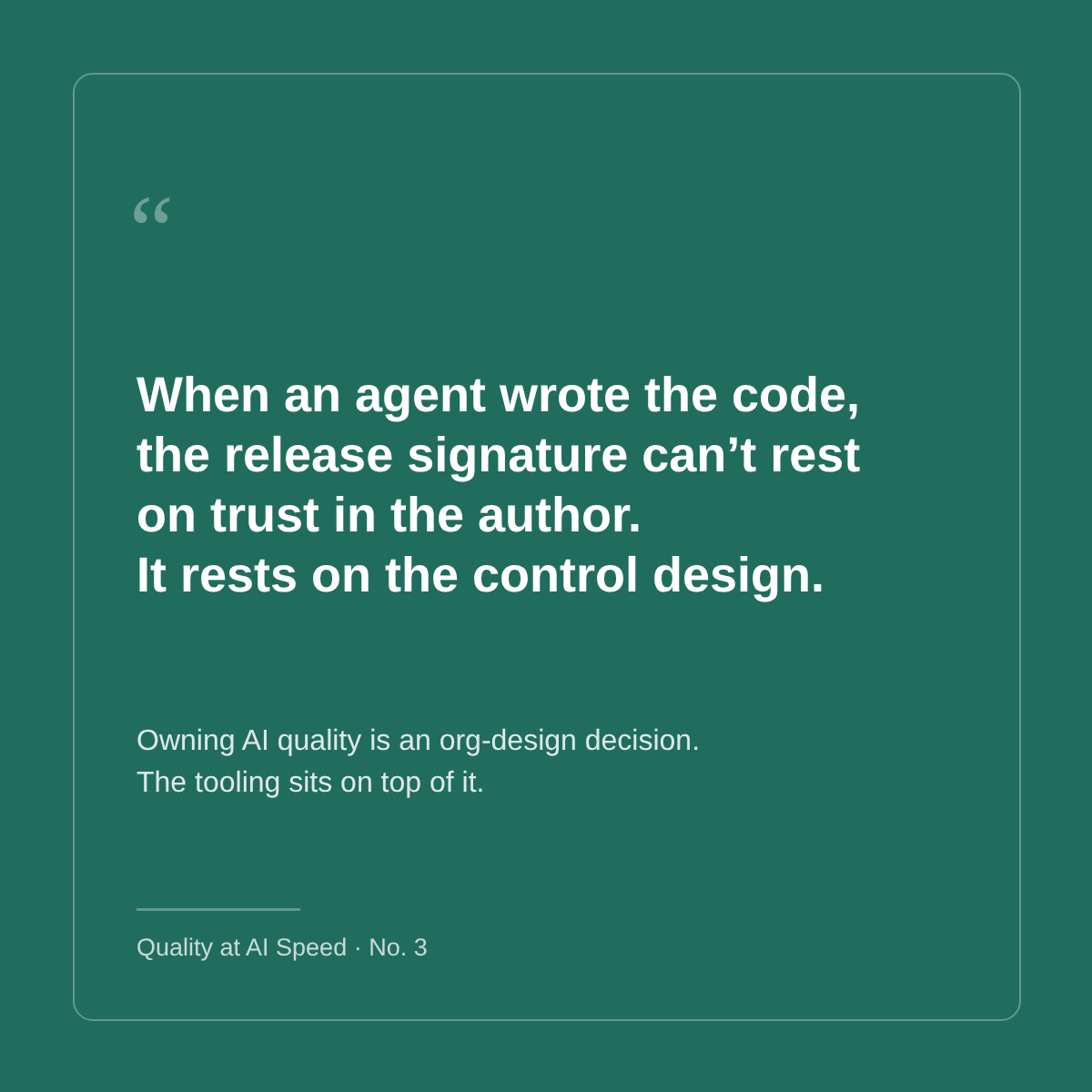
Ownership of quality is an org-design decision. You can't buy it as a tool. And most organisations are running one of four designs without ever having chosen it.
The two questions under every ownership model
Strip away the org charts and two questions decide how quality is owned:
- Who designs the controls? Who decides what gets checked, how hard, and what evidence counts as "good enough to ship"? This is either central, with one function setting the standard, or distributed, with each team setting its own.
- Who executes the checks? Is the evidence mostly produced by people exercising judgment, or by automation: pipelines, policy-as-code, agents reviewing agents?
Cross the two and you get four modes. Each one is a reasonable design. Each one also fails in its own way once delivery runs at machine speed.
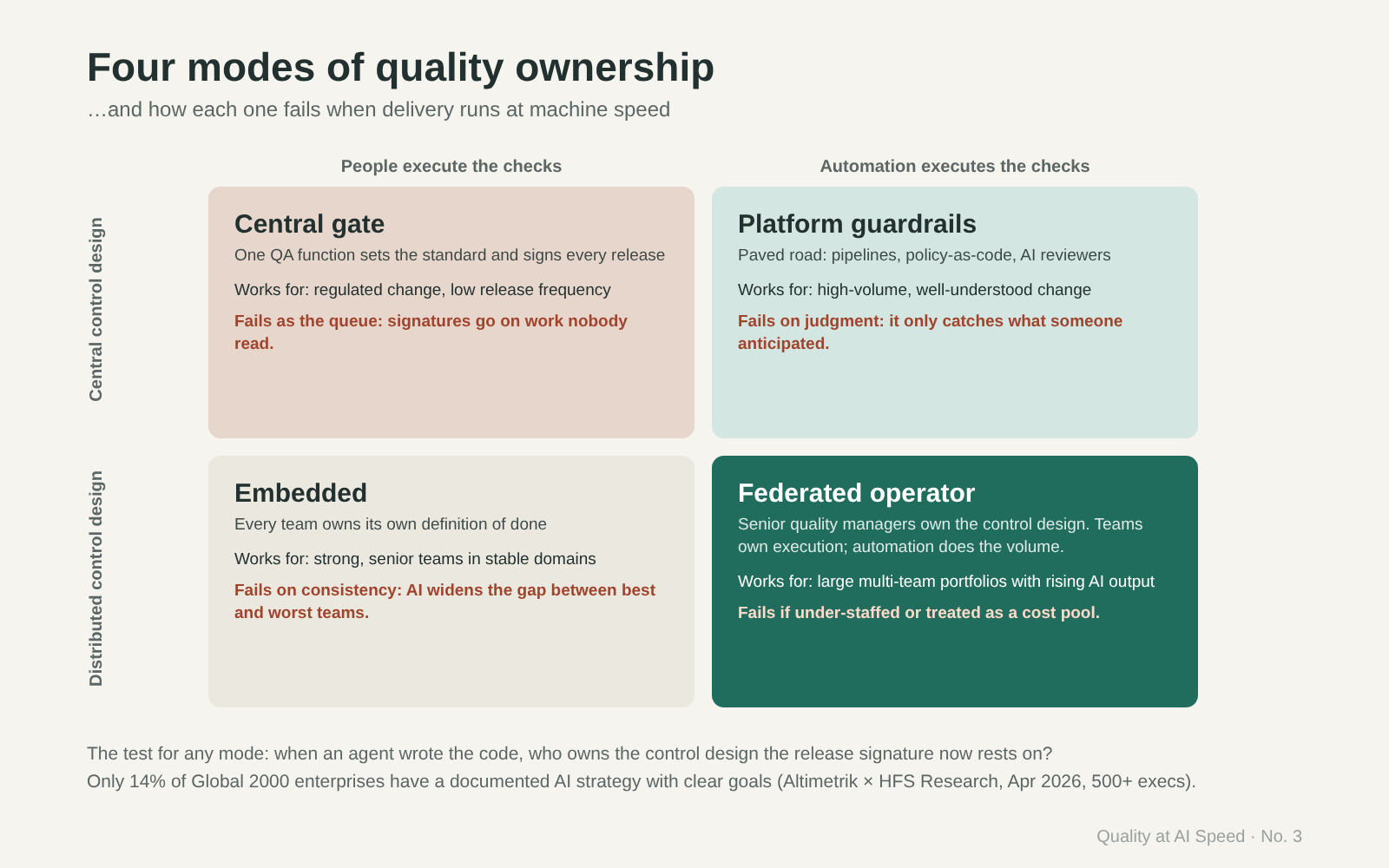
Mode 1: Central gate (central design, people execute)
One quality function owns the standard and signs every release. This is the classic QA department with a release sign-off.
Where it works: regulated or safety-relevant change, small portfolios, low release frequency.
How it fails at machine speed: it becomes the queue. When agents raise output several times over, the human gate either turns into the bottleneck or gets waved through. A signature applied to work nobody had time to read is worse than no signature, because it looks like assurance.
Signal you're failing: release approvals cluster at the end of the day and nobody can tell you what evidence the signer actually looked at.
Mode 2: Embedded (distributed design, people execute)
Every team owns its own quality, with "you build it, you test it." Quality engineers, where they exist, sit inside teams and answer to delivery leads.
Where it works: strong, senior teams with stable domains and a culture of craft.
How it fails at machine speed: consistency. Twenty-five teams make twenty-five definitions of "done" and twenty-five different appetites for risk. Agent output amplifies whatever discipline each team already has (DORA's amplifier finding, from No. 2), so the spread between your best and worst team widens every quarter. At portfolio level, nobody can answer "how safe is what we shipped this month?"
Signal you're failing: incident post-mortems keep finding the same class of defect in different teams, each surprised by it.
Mode 3: Platform guardrails (central design, automation executes)
Quality becomes a paved road. Mandatory pipelines, policy-as-code, automated scanning, and AI reviewers enforce one standard everywhere without a human in the loop for routine change.
Where it works: high-volume, well-understood change where the failure modes are known and testable.
How it fails at machine speed: judgment gaps. Guardrails catch what someone anticipated. Code written by AI tends to look correct and still fail in production, so the failures that matter most are the ones nobody wrote a rule for. A green pipeline turns into a proxy for "safe," and the organisation stops asking the question the pipeline can't answer.
Signal you're failing: pass rates rise and incident rates don't fall. Nobody owns updating the guardrails after an escape.
Mode 4: Federated operator (central design, distributed execution, people on the automation)
A small senior quality function owns the control design across the portfolio: risk classes, required evidence, gate placement, and how humans review machine output. Teams own execution, and automation does the volume. Quality managers aren't the gate. They decide how strict each gate should be and keep it honest.
Where it works: large, multi-team portfolios where AI is producing a growing share of change. This is the design I'd argue for, and it's closest to how I run quality today: several quality managers across 25+ teams and 400+ engineers, with each manager owning the control design for a slice of the portfolio. The teams own whether it ships.
How it fails: if it's under-staffed, or treated as the cost pool to drain once "the AI does testing now," it decays into Mode 3 with a few extra meetings. The operator role only works if it's senior, sits close to the risk, and has the authority to change a gate. That's the "AI operators, not a layoff pool" point from No. 2, made structural.
Signal you're failing: the quality managers spend their week chasing sign-offs and never get to redesigning the controls.
Who signs the release now?
This is where the framework stops being abstract. A release signature used to rest on trust in the people who wrote the code. When an agent wrote it, that trust has nothing to attach to. The signature has to rest on trust in the evidence and in how the gates were designed.
So the question for a signer isn't "did the team test it?" It's "do I trust the control design that produced this evidence, for this risk class?" Only Mode 4 has an owner for that question. In Mode 1 the signer is too busy to ask it. In Mode 2 every team answers it differently. In Mode 3 nobody is asking. Whatever the tooling, the accountability stays human. The real choice is whether it sits with someone who has the time, the authority and the cross-team view to carry it.
The board version
If you take one thing to your next leadership or board conversation, make it this:
- Name the mode you're actually in. Most organisations say "embedded" and actually run "platform guardrails with nobody watching the guardrails."
- Name an owner per risk class, not per team. Low-risk change can run on Mode 3. Customer-facing, financial or regulated change needs a named human owner of the control design.
- Fund the operator layer before you scale agent output. The cost of ownership is a few senior people. The cost of no ownership is spread across every incident, and none of it shows up on a headcount slide.
I go deeper on the control-design side in my published "Quality at Machine Speed" chapter of the AI Transformation anthology.
If you're leading quality through AI-built delivery too — where did it land for you? In particular: which of the four modes is your org actually in, and does it match the one on the slide?
Quality at AI Speed is a weekly column on quality, risk and delivery when software is built and reviewed at machine speed. This is No. 3. Previously: No. 2 — Your QA team is the cheapest AI insurance you'll ever buy · No. 1 — The vendor that admitted it can't test its own model. The column continues from the orchestration series.