Your QA team is the cheapest AI insurance you'll ever buy
AI made code cheaper to produce and more expensive to trust. 74% of tech leaders already pay to rework AI code; only 3.7% of engineering leaders think their process can govern quality as agents scale. Cutting QA to fund AI isn't a saving. It's a deductible you pay in production.
Quality at AI Speed · No. 2
There's a slide going around in a lot of leadership decks this year. It says: the AI writes the code now, so the quality function is a cost we can finally cut. The logic feels airtight. Fewer hands on the keyboard, fewer hands checking the keyboard. The savings are right there in the headcount line.
I want to make the opposite case, and I want to make it in the language that slide is written in — money.
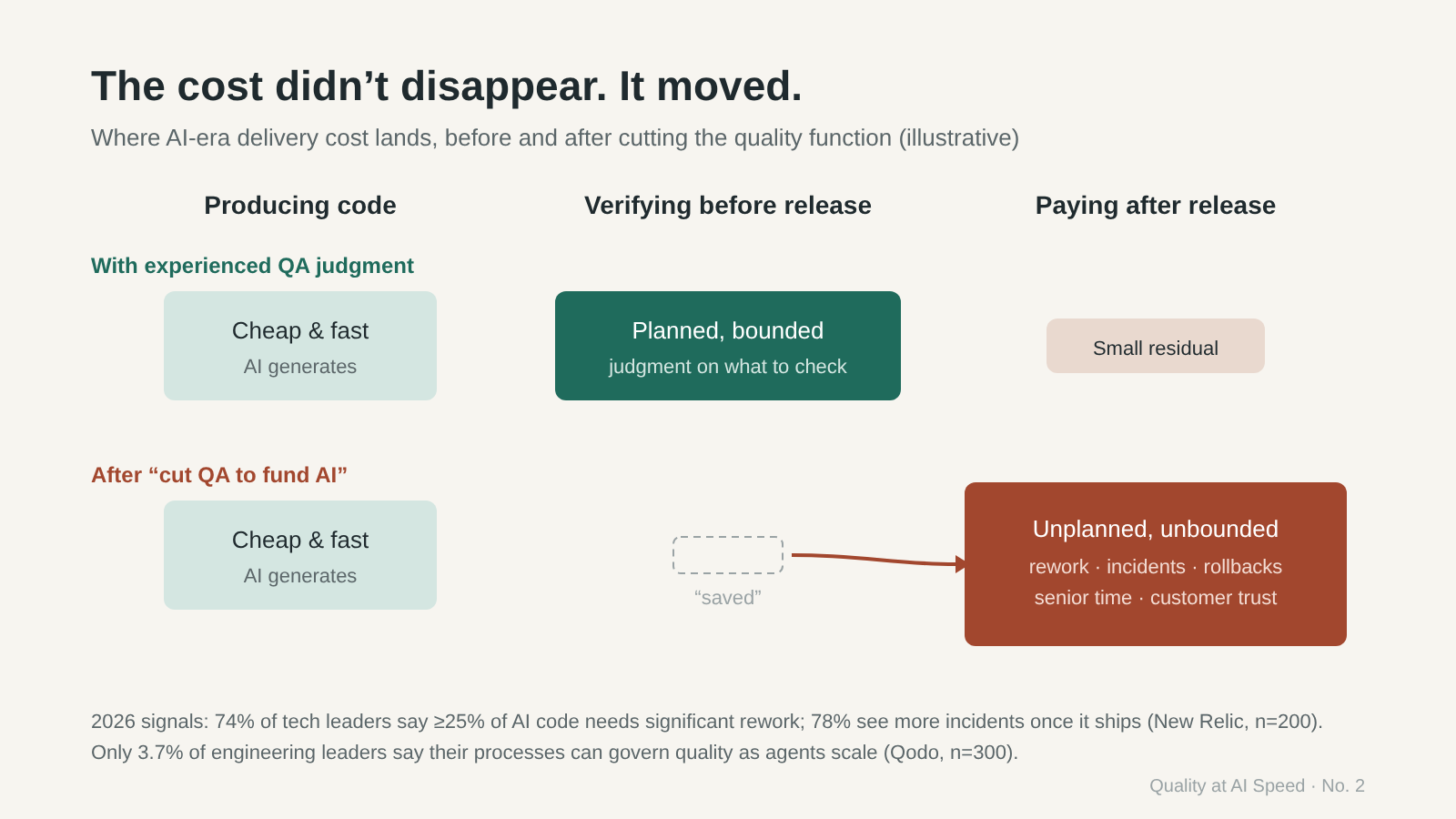
The cost didn't disappear. It moved.
Here is the part the savings slide leaves out. The AI-generated code doesn't arrive finished. It arrives fast, and then someone pays to make it trustworthy.
The 2026 numbers are no longer vague. In New Relic's 2026 survey of 200 US technology decision-makers, 74% said at least a quarter of their AI-generated code needed significant rework over the past year. Once that code shipped, 78% reported more incidents, 86% said their senior staff were spending more time fixing code, and 82% had at least one production failure tied to AI-generated code in the previous six months. The same report's headline is the uncomfortable one: AI-written code grades higher in review and still triggers more incidents in production. It reads as correct more often than it is. The single most-cited finding of the year, from Google's DORA program, is that AI is an amplifier: it makes a disciplined team faster and a sloppy one faster at making messes. It raises your ceiling and your blast radius at the same time.
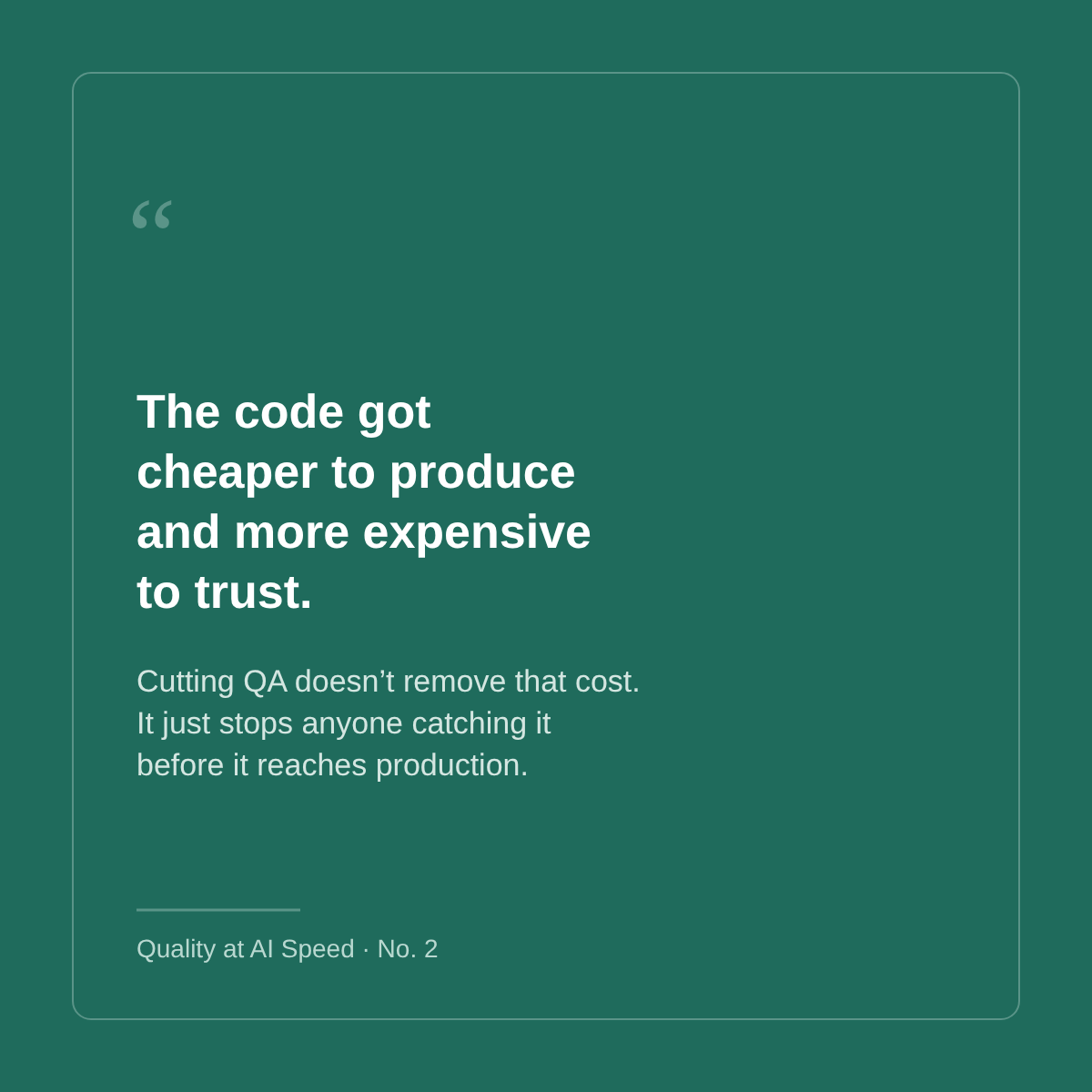
So the code got cheaper to produce and more expensive to trust. That second cost doesn't show up on the headcount slide because it lands somewhere else — in incidents, in rollbacks, in the senior engineer's week quietly eaten by cleanup, in the customer who hit the bug before your dashboard did. Cutting the quality function doesn't remove that cost. It just stops anyone from catching it before it gets expensive.
That's not a saving. That's a deductible you've chosen to pay in production.
Review is the bottleneck now — and that's the tell
Ask the people doing the work and they'll tell you where the constraint went. In Qodo's 2026 State of AI Code Quality report, only 3.7% of engineering leaders said their existing processes were sufficient to maintain quality and governance as agents take on more work. Reviewing the output, not generating it, is the job that now takes the time and the cognitive load.
Think about what that means. The scarce resource in AI delivery is no longer typing. It's judgment applied to machine output at speed — knowing what to check, what a failure would cost, and when a confident answer deserves a second look. That is precisely, exactly, the thing an experienced quality function is for. You don't have a code-generation problem anymore. You have a verification problem. And you were about to lay off the verification team to save money.
The reframe for the board
So here's how I'd put it to a CFO, not a test manager:
Your QA function is insurance, and AI just raised your premiums-worth-of-risk. The faster you ship code no human fully reasoned about, the larger the tail risk you're carrying. Insurance is not where you cut when the thing you're insuring against gets more likely.
The judgment is the asset, not the headcount. The value isn't bodies running test suites — the machines can run suites. It's experienced people deciding what's worth checking and what a mistake means in your domain. That judgment is scarce, it's slow to build, and it's the exact capability the market is short on. Treating it as a cost pool to drain is selling the one thing that's appreciating.
"AI operators," not "a layoff pool." The strongest version of a quality function in 2026 isn't a group that gets smaller as the AI gets better. It's a group that gets repositioned — from running the checks to designing the controls that keep hundreds of engineers and their agents shippable. That's a more senior, more leveraged, more valuable function than the one you had. It is not a line to trim. It's the one you promote.
The short version
The savings slide is real arithmetic done on the wrong line. AI made code cheap to produce and expensive to trust, and the trust cost is landing in your incidents and your rework while you look at the headcount column. The 2026 data is blunt about it: three in four tech leaders are already paying to rework AI code, review is the new bottleneck, and fewer than four in a hundred engineering leaders think their process can govern quality as agents scale. In that world, experienced quality judgment is the cheapest insurance you can buy against a risk you've just made bigger — and the function that provides it is the last one you should be cutting. I argued the long version in the published "Quality at Machine Speed" chapter of the AI Transformation anthology.
If you're leading quality through AI-built delivery too — where did it land for you? Specifically: if you've watched the "cut QA to fund AI" math up close, where did the cost actually resurface?
Quality at AI Speed is a weekly column on quality, risk and delivery when software is built and reviewed at machine speed. This is No. 2. Previously: No. 1 — The vendor that admitted it can't test its own model. The column continues from the orchestration series.