From Idea to Working Product: How AI-DLC Unlocks Human Creativity
A 90-minute CAST 2026 session on a 20-month experiment: going from zero iOS knowledge to an App Store release by directing AI agents instead of writing code.
By Michał (Mike) Buczko, quality and delivery leader at Carrier/Viessmann and founder of BowSmith.
AI lowered the cost of producing code. It did not lower the cost of making that code trustworthy. This talk makes that argument with one case: a 20-month experiment in which I went from zero iOS knowledge to an App Store release of BowSmith, an archery companion app, by directing AI agents instead of writing code.
By AI-DLC I mean fully AI-driven delivery: design, architecture, development, testing and documentation are all done by AI. As the human orchestrator I talk to one AI coordinator, which does the work itself or through subagents.
What the talk covers
- Five phases in 20 months: web chat, Cursor, role-based agents, skills with the RPIQ loop, and task-based Agent Teams. My role changed in each one, from typist to orchestrator.
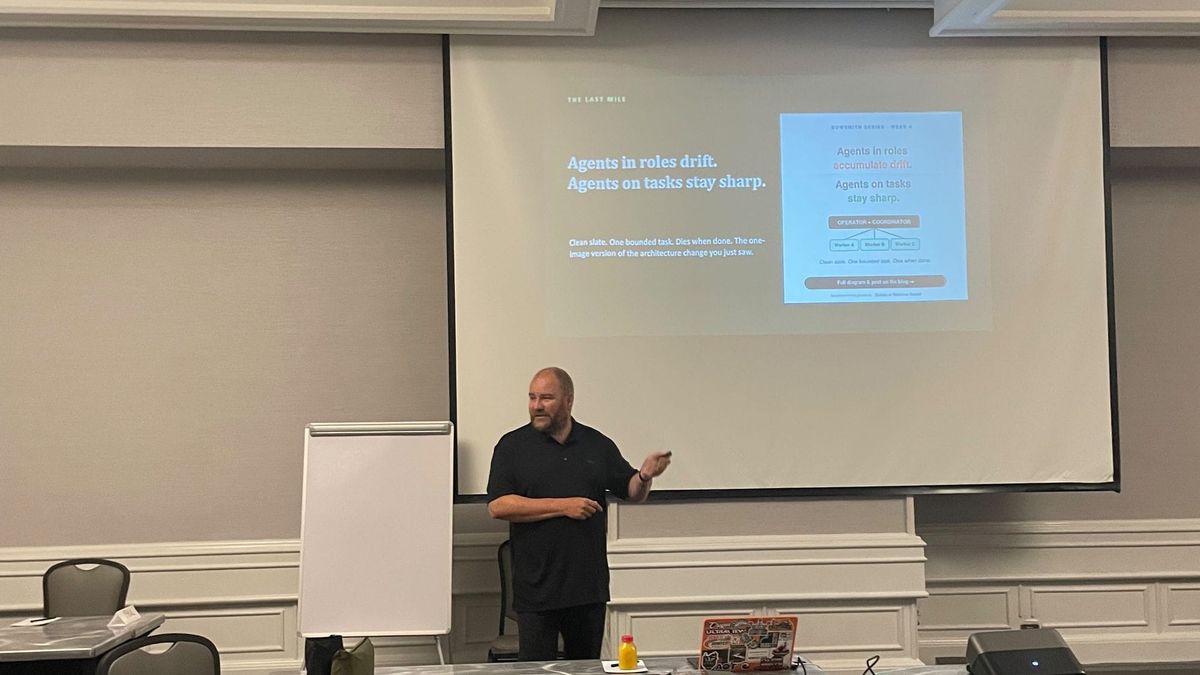
- Why my first team of role-based agents failed. I started with 32 role profiles and only 17 survived; they still suffered from duplicated context, scope creep, and roles that did not map to real tasks. Disposable, task-based agents with fresh context replaced them, and today six to eight remain, built around skills.
- The method: RPIQ (Research, Plan, Implement, Quality) and a CLAUDE.md file that every agent reads in every session.
- Review that works: same-model review approved almost everything, so a different model reviews the work.
- Blocking gates on AI-generated code: dead-code detection, duplication detection and the test suite. A failed gate sends its report back to the agent, not to me.
- A live tour of the real working folder: rules, agent definitions, skills and gates.
Who it is for
Testers, quality engineers and engineering leads who are past asking whether AI does anything useful and want to know how to compose it into something reliable. No iOS or Swift knowledge is needed.
What you take away
- A structure to copy: one coordinator, and workers that each get a task brief, a file list and exit criteria.
- A reason to stop reading test count as a quality signal: AI writes tests that match the code, not the specification.
- A description of where the quality role went: from reviewer to architect of evidence.
Where I have given it
- CAST 2026 (Association for Software Testing), Cocoa Beach, Florida, Tuesday 4 August 2026. Invited speaker, Technology track, 90 minutes.
In the open season after the talk, the room challenged three things: what the monthly cost figure measures, whether test count means anything, and how much of the result came from my QA background. Recaps: open season as a quality gate and what a room of testers did to the thesis. Background: the whole system on one page and from 17 role-based agents to task-based Agent Teams.
Slides
Deck as presented: PDF, 4 MB.
Format and practical details
- Length: 90 minutes at CAST, including a live tour of about 20 minutes.
- Language: English.
- Room and tech: the session includes a live terminal tour with a pre-recorded fallback.
Related talks
- From Tester to AI Operator: 20 Months of Shipping with AI Agents
- Is AI the future of Software Delivery: Can it replace a Feature team?
- Workshop: Design Your Quality Gates for AI-Assisted Delivery
Book this talk
To book this talk, start at the Speaking page, book a 30-minute call or message me on LinkedIn.
