Writing tests is cheap now. Deciding what they are for is not.
When a machine can generate thousands of tests in an afternoon, the scarce resource is no longer automation. It is the decision about what each test is meant to prove, and which ones deserve to run first.

Most teams still treat test automation as a production problem: not enough tests, not enough people to write them, not enough time. That problem is gone. What is left is a judgement problem, and it is harder.
For most of my career, automation strategy was a conversation about scarcity. You had a handful of automation engineers, a backlog of manual regression cases, and a release date. Prioritisation meant choosing which tests to write first, because you could not write them all. The constraint shaped the strategy, and the constraint was capacity.
BowSmith has roughly 70,000 automated tests. I did not write them by hand, and nobody on a traditional team would have either. They were generated, reviewed and gated as part of an orchestrated pipeline. That number is not the achievement. It is the warning. Once tests stop being expensive to produce, the old prioritisation logic quietly stops working, and most teams have not noticed yet.
Volume is not coverage, and coverage is not confidence
A large suite feels like safety. It is not the same thing. A suite is a collection of claims about the system, and a claim is only useful if it is the claim you needed someone to make.
The failure I watched happen in my own pipeline was specific: AI-generated tests adapted to the code, not to the requirements. Ask a model to write tests for a function and it will read the function, infer what it does, and assert that it does that. The suite goes green. It would also have gone green if the function had been wrong, because the test was derived from the wrong thing. That is not verification. That is transcription.
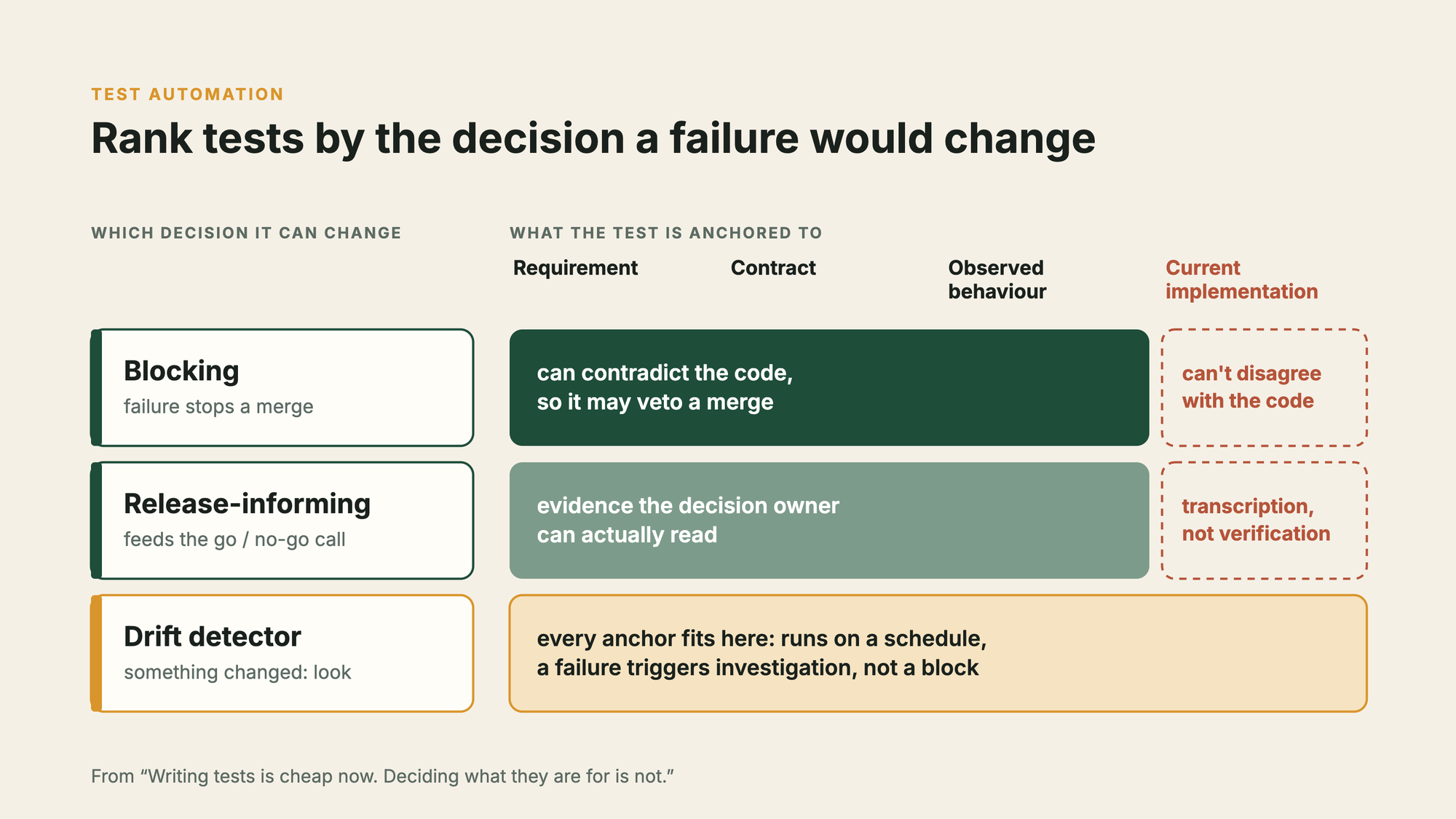
So the first strategic question is no longer "how many tests do we have?" It is "what is each test anchored to?" A test anchored to a requirement, a contract or an observed user behaviour can disagree with the code. A test anchored to the code cannot. Only the first kind earns its place in a prioritised run.
The check: pick ten tests at random from your suite and ask, for each one, what source of truth it would contradict if it failed. If the honest answer is "the implementation as it was written", you have a regression detector, not a correctness check. Both have value. Only one of them belongs at the front of the queue.
Prioritise by the decision a failure would change
The classic advice on prioritisation is risk-based: weight by likelihood of failure and impact of failure, run the high-risk cases first. I still agree with it. I just think the framing undersells what prioritisation is for.
A test run exists to inform a decision. Merge or don't. Release or hold. Roll back or ride it out. A test that cannot change any of those decisions, whatever its result, is not a priority, no matter how important the feature it touches sounds. I made a version of this argument about metrics years ago, in the test:fest 2022 workshop on KPIs, metrics and statistics: measure for decisions, not for numbers. Tests are measurements. The same rule applies.
In practice that gives you three tiers, and they map to the decisions rather than to the test pyramid:
- Blocking tests — the ones whose failure must stop a merge. Small, fast, anchored to contracts and critical paths. If one of these is flaky, it is not a test, it is noise with a veto, and it gets fixed or demoted the same day.
- Release-informing tests — broader integration and end-to-end runs whose results feed a go/no-go decision. They can be slower. They must be readable by whoever owns that decision.
- Drift detectors — the long tail. They exist to tell you something changed, not that something is wrong. They run on a schedule, and a failure triggers investigation rather than a block.
Most suites I review have no such separation. Everything runs everywhere, everything can fail the build, and so the team learns to retry, quarantine and ignore. A suite that blocks for everything ends up blocking for nothing.
The pyramid still holds. The reason for it changed.
I re-shared the test pyramid years ago, and I still build that way. Many fast unit tests, fewer integration tests, a thin layer of end-to-end. But the original justification was cost: unit tests were cheap to write and cheap to run, UI tests were expensive on both counts.
Generation has flattened the writing cost. A model will produce an end-to-end test about as easily as a unit test. The run cost and the diagnostic cost have not moved at all. An end-to-end failure still tells you that something, somewhere, is wrong; a unit failure tells you where. When generation makes the top of the pyramid cheap to grow, the discipline has to come from somewhere else, because the economics will no longer enforce it for you.
That discipline, for me, is a rule about where a test lives and what it may assert. Tests are kept separate from the product code they verify, so the thing being tested cannot quietly reshape its own examiner. And new tests at the top of the pyramid need a reason that cannot be met lower down. "It was easy to generate" is not a reason.
The check: look at the last month of new end-to-end tests. For each, could the same behaviour have been pinned at the unit or integration level? If most of them could, your pyramid is inverting, and your pipeline time is about to tell you so.
Value, not volume, not ROI
Back in 2019 I argued that we should stop justifying test automation through ROI and talk about value instead. The point then was that ROI counted hours saved on manual execution and missed the things automation actually buys: earlier feedback, safer refactoring, faster decisions.
The argument is sharper now. When the cost side of the ROI equation collapses towards zero, every test looks profitable. That is exactly when the calculation becomes useless. The cost that matters is not writing the test. It is maintaining it, running it, diagnosing it when it fails, and trusting it when it passes. A test that fails for reasons nobody can explain costs more than it returns, however cheaply it was produced.
How I would set an automation strategy today
If I were starting a team's strategy from scratch in late 2026, I would not start with a tool or a coverage target. I would start with four questions:
- What decisions does testing feed? List them. Merge, release, rollback, customer communication. Every test should map to at least one.
- What is each test anchored to? Requirement, contract, observed behaviour, or current implementation. Label them. Prioritise the first three.
- Who owns a red result? Not "the team". A named person or role, with the authority to block and the duty to explain.
- What would we delete? If you cannot name tests you would remove, you are not prioritising. You are accumulating.
None of this is new as theory. Risk-based testing, the pyramid, ownership of failures — testers have argued for them for decades. What is new is that the constraint that used to enforce them, the cost of writing tests, has disappeared. The strategy has to do the work that scarcity used to do for free.
Speed of generation is not the achievement. A suite where every test can tell you why it exists is.
If you are wrestling with a suite that grew faster than anyone's understanding of it, that is exactly the kind of problem I like to talk through in a Quality Coffee session. And if you are not subscribed yet, the next post, "A test result is only as true as the environment that produced it", is about the other half of this problem: the environments and data your tests run against, and why a result means little without the place it was produced.
